A3 · Kotlin Multiplatform · SwiftUI · Jetpack Compose · Supabase
Tek'Notes !
A pocket notebook so you stop forgetting the soundsystems and artists you come across at tekno parties, filled in over time by the people who come across them.
- Role
- Idea, design, development of both apps and the server
- Context
- Personal project
- Year
- 2026
- Platforms
- iOS, Android
- Status
- Test version on my iPhone, not published yet
Interactive preview
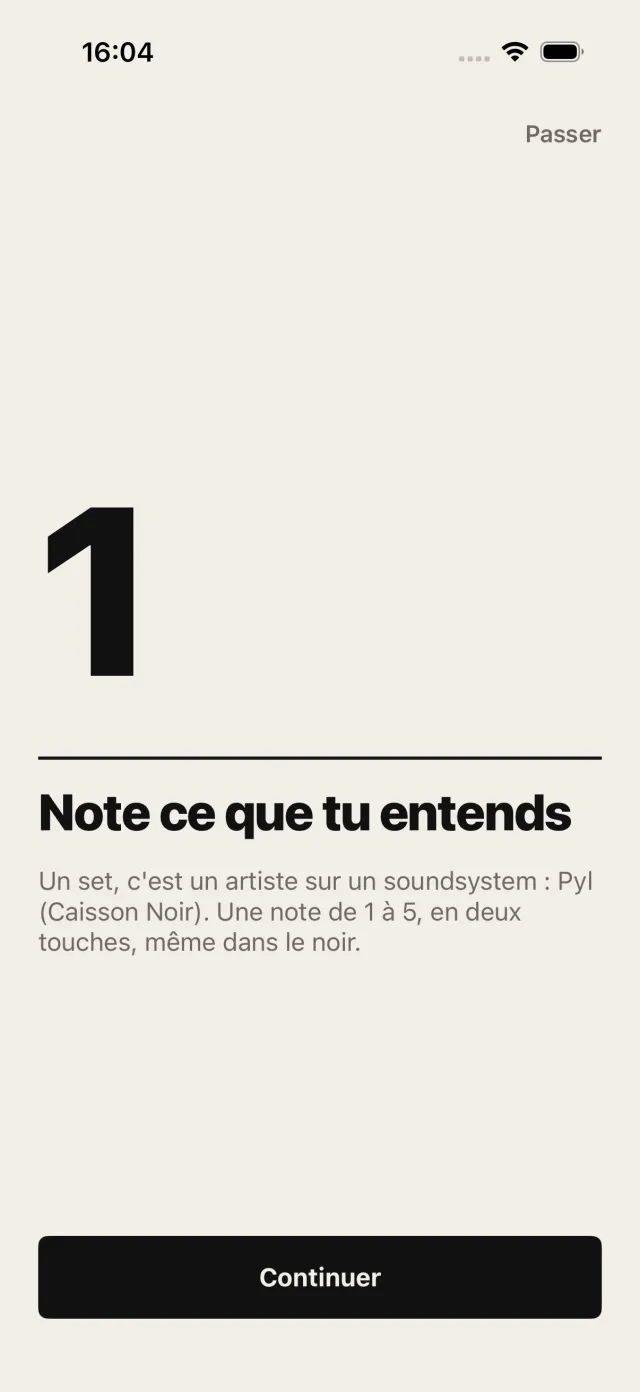
01 / 14
Introduction
Tap the right side of the screen to go forward, the left side to go back, or swipe.
Screenshots · 14
01A name forgotten by the next day
You leave a big session in front of a magnificent wall of sound. One track floored you, and the next day you can’t find out who was playing. The name is stuck in a story that’s already expired, or in your phone notes between a shopping list and a Wi-Fi password.
Music apps aren’t much help here: a good part of this scene isn’t on any platform.
02Self-sufficiency: a directory that fills itself
It’s the same idea as in Swikko: self-sufficiency (“autosuffisance” in French). Nobody fills the catalogue in advance. When someone logs a soundsystem or an artist that isn’t in the app yet, they create the entry, and it becomes available to everyone. Every entry can be corrected like a wiki, with its .
There’s no administrator approving each addition. The app warns when an entry , the community can propose a merge, an entry or block someone, and a heavily reported entry hides itself.
03What you can do with it
You start with a short , then fills up night after night.
- log a party in two taps, or by voice, with the venue, the soundsystems and the artists;
- add to a set (an artist on a soundsystem), a rating from 1 to 5 and a comment;
- keep everything offline: the notebook works without an account and without a network;
- find a name by place, artist or date, ;
- protect the app with a on opening.
is shared: you search it, and with an account you create and correct entries. shows its aliases, styles, artists and the nights shared by others.
04On the technical side
I chose Kotlin after a very interesting class given by a visiting lecturer who explained things really well. It gave me the idea of writing the core of the app once, in Kotlin Multiplatform: the models, the search, the rules and the local database.
On top of it, two native apps: SwiftUI on iPhone and Jetpack Compose on Android. Each screen is written once per platform, but the logic exists in a single copy.
On the server side, Supabase (Postgres) with access rules written in SQL and tested automatically on every change. Changes made offline wait in a local queue and go out as soon as there’s a network.
05Where it stands
The first version is written and tested, and I’m trying it on my iPhone with demo data that is clearly fictional: it’s what the screenshots on this page were taken with. It isn’t published yet: I still have to set up the production server and get the legal texts reviewed. The code is public.
Next track · A4
Lueur →
Play side BAbout
That’s side A. To find out who’s behind it, flip the record.